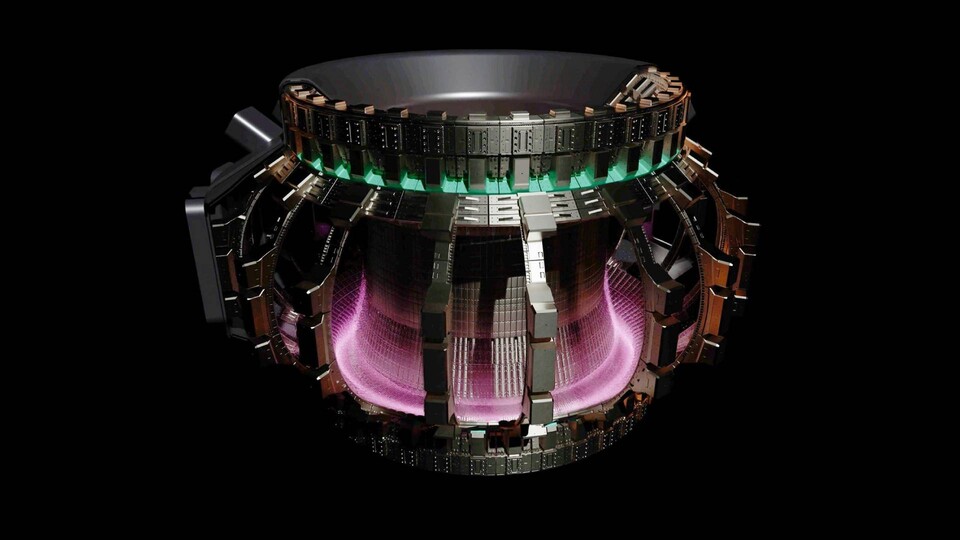
A visual illustration of SPARC’s digital twin. (Image: Commonwealth Fusion Systems)
One of the biggest challenges in the further development of AI is the question of how sufficient energy can be produced. NVIDIA, Siemens and Commonwealth Fusion Systems (CFS) announced a promising alliance at CES 2026.
AI should be powered by the power of the sun
CFS is considered one of the world’s leading companies in the field of nuclear fusion. The first plasma is scheduled to be ignited in the SPARC fusion reactor near Boston in 2026. Potentially, reactors of this type could solve many energy problems.

1:53:19
The AI hype is eating itself – tech annual review 2025
This is the SPARC fusion reactor: The SPARC is a “tokamak” type reactor. It is shaped like a donut and is supposed to keep plasma, i.e. extremely hot gas, in suspension using strong magnetic fields.
At temperatures of over 100 million degrees Celsius, hydrogen isotopes fuse to form helium, releasing enormous amounts of energy. The goal is to use fusion to produce more energy than is needed to keep the fusion going.
Digital twin: It was announced that Siemens and NVIDIA are jointly building a virtual image of SPARC. Siemens Xcelerator as well as Omniverse and OpenUSD from NVIDIA are used.
This digital twin should then significantly accelerate the further development of the reactor. Experiments that would otherwise take years could be simulated in just a few weeks. Errors can be found before a component has even been assembled.
Interaction with AI: All of this is intended to help cover the immense energy requirements that arise, among other things, from the AI boom. SPARC is comparatively compact; data centers could theoretically operate their own ARC reactors (the commercial version of SPARC) at some point and thus produce their own energy directly on site.
On the other hand, the development of SPARC would probably not be possible at all without AI. AI models calculate in milliseconds how the magnetic fields need to be adjusted to keep the plasma in the reactor stable. AI therefore actively helps to develop energy sources that are needed for AI.
Editorial opinion

Gerald Weßel: This is all a logical and equally clever next step. Nuclear fusion and computing capacity have always been closely linked, and AI is now taking this symbiosis to the extreme. I think it is entirely conceivable that merging the two will shorten the waiting time for the first fusion reactor from decades to years.
However, the creators of SPARC are putting a bit too much emphasis on their argument. Before we talk about miniaturization towards decentralized individual reactors for individual data centers, we first need large-scale central systems. Here the history of technology is merciless: in order to create something tiny, we first have to master it on a large scale.
But even if SPARC ultimately loses out to tokamak projects like ITER in France, the following applies: Of the dozens of concepts currently competing with each other in nuclear fusion, the winner will use AI – and the energy now eaten will help to develop a new energy source more quickly.
The Best Online Bookmakers March 11 2026
 Bonus€500+ 200 Free spins |
 Bonus€1,000 |
 Bonus€200 |
 Galaxy Tab S10 Lite is really cheap right now
 Why I use a fan in winter and why I especially rely on this model!
 Spotify is increasing its prices again in the USA – what that means for us
 Dead Cells Studio surprises with a roguelite insider tip