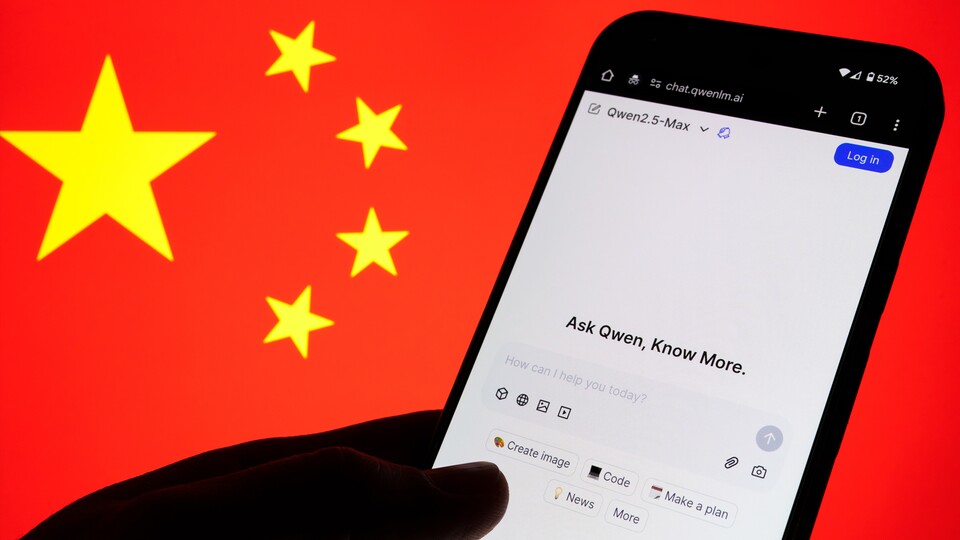
The Chinese company Alibaba has already made a name for itself with the Qwen models: The latest model Qwen3-Max-Thinking doesn’t have to hide from Google. (Image source: Ascannio, Adobe Stock)
Gemini vs. ChatGPT: Since the announcement of the cooperation between Apple and Google for the new Siri, most people have seen a gap between the Silicon Valley companies Google and OpenAI. And it seems clear: There is now a lot to criticize about ChatGPT.
However, you rarely read about competition from the Far East, or more precisely: China. Since DeepSeek briefly dominated the media in 2025, things have become quiet. But recently the Alibaba company has been extremely popular in the developer scene with its Qwen models.
Recently, their flagship, Qwen3-Max-Thinking, was released – and it’s not afraid to take on Google’s latest bang in the form of Gemini 3 Pro.

56:01
GameStar Tech Talk: Is AI going too far?
The benchmark test: Gemini dominates in most categories
The Qwen models are various open-weight language models from the Chinese company Alibaba, which primarily serves us as the parent company of Chinese Amazon
AliExpress is known.
On January 26, 2026, the Qwen team released their new flagship model Qwen3-Max-Thinking.
In the accompanying announcement, the Chinese company positions it as a direct challenger to Google’s AI Gemini and states: Qwen3-Max-Thinking beats Gemini 3 Pro in the most important reasoning benchmarks
.
The benchmarks presented were collected by the Qwen development team themselves. As is usual in the industry, a certain pre-selection in favor of your own model cannot be completely ruled out.
Nevertheless, the technical report paints a differentiated picture of the current AI competition with standardized test metrics:
- Google remains the leader: Overall, Gemini 3 Pro leads in 11 of the 19 categories listed.
- Qwen, the specialized challenger: Qwen3-Max-Thinking wins in the remaining 8 of the 19 categories in the benchmark test. Furthermore, the distance to Google is minimal in many areas.
- The strengths of Gemini 3 Pro: Google dominates primarily in the areas of general knowledge, STEM subjects and coding. Gemini also has the upper hand when it comes to analyzing long contexts and tool usage (such as API interfaces).
- The strengths of Qwen3-Max-Thinking: Qwen primarily exerts his superiority in the area
Reasoning
– an important category that has helped language models make a significant leap in development in recent years. - With a score of 90.2 compared to its direct pursuer Gemini 3 Pro with 81.7, the Chinese model has the edge in the Arena-Hard v2 benchmark
Instruction Following
clearly in front.
In short, this means: With Qwen, users have a significantly higher probability that their instructions will be implemented precisely on the first try and without unnecessary questions.
Not just the performance: Qwen clearly impresses in one thing
Apart from values in benchmark tables, Qwen has a decisive advantage over Google: it is simply cheaper.
If you compare the pricing of Google versus Alibaba for the use of the respective API, the following stands out:
- Half price edition: While Google charges $12 per million tokens for text output, Qwen is exactly twice as cheap at $6.
- Cheaper input: You can also save significantly when reading data (prompts) with Qwen – the price is around 1.7 times lower than with Gemini 3 Pro.
- Context becomes expensive: Google doubles its prices as soon as a request is longer than 200,000 tokens. Qwen waives such a surcharge, making it significantly cheaper for large amounts of data (e.g. long analyses).
This could also be a reason why the Qwen models – as Deutsche Welle reports – are currently the most downloaded open-weight solutions in the world, now ahead of Mark Zuckerberg’s Llama models.
It’s not all gold: Qwen for private users
The prices and certain benchmarks are particularly interesting for professional users and developers. Before everyday users use Qwen3-Max-Thinking as a personal chatbot via Qwen.Chat, they should consider a few points:
- Lack of data protection: In its terms and conditions, Qwen states that user input is not
confidential and not legally protected
(non-confidential and non-proprietary
) are. This means: Your data can be further processed, for example for training purposes. Business customers, on the other hand, have the opportunity to object to data processing in the Alibaba Cloud. - Chinese law: With regard to China, as the Tagesschau reported, data protection advocates criticize the Chinese intelligence law, which…
Population and organizations to cooperate with the security authorities
obligated. This also applies to companies like Qwen.
It remains questionable whether models from the Qwen family will enjoy the same trust among private customers in the future as those from OpenAI or Google. As you often read in forums, people often use them as a substitute for therapists – a quite problematic trend.
However, anyone interested in the battle between the AI giants has to look beyond California and from there will first turn their attention to China.
Here, almost unnoticed by many, a quiet but powerful market for large language models has developed – and with Qwen3-Max-Thinking a strong flagship has emerged.
The Best Online Bookmakers February 05 2026
 Bonus£10 |
 Bonus- |
 Bonus£20 |
 The LEGO competition now lets you build a working biturbo V8 yourself
 This dartboard costs over €1,000, but the price is surprisingly fair
 2026 will see the start of a new trend in headphones that I have wanted for years: two opposites will be united
 If you hurry, you won’t pay 7 euros for 4 high-quality USB-C-to-C cables